Why the default 25/5 isn't right for everyone
The classic 25-minute work session and 5-minute break isn't a law of nature — it's the length Francesco Cirillo happened to settle on for himself in the late 1980s, using a kitchen timer shaped like a tomato. It stuck because it's an easy, approachable default, not because 25 minutes is the objectively correct unit of human focus.
In practice, how long you can hold sharp attention depends on the task, your energy that day, how much sleep you got, and plain individual differences. A quick task like clearing a short inbox can suit a tight 15-minute sprint. A deep task like writing, coding, or studying for an exam often needs a longer, uninterrupted runway before you actually reach a state of flow — by which point a 25-minute timer can feel like it's cutting you off just as you get going. That's the case for a timer that lets you set your own numbers instead of only offering the classic ratio.
How to set your own intervals here
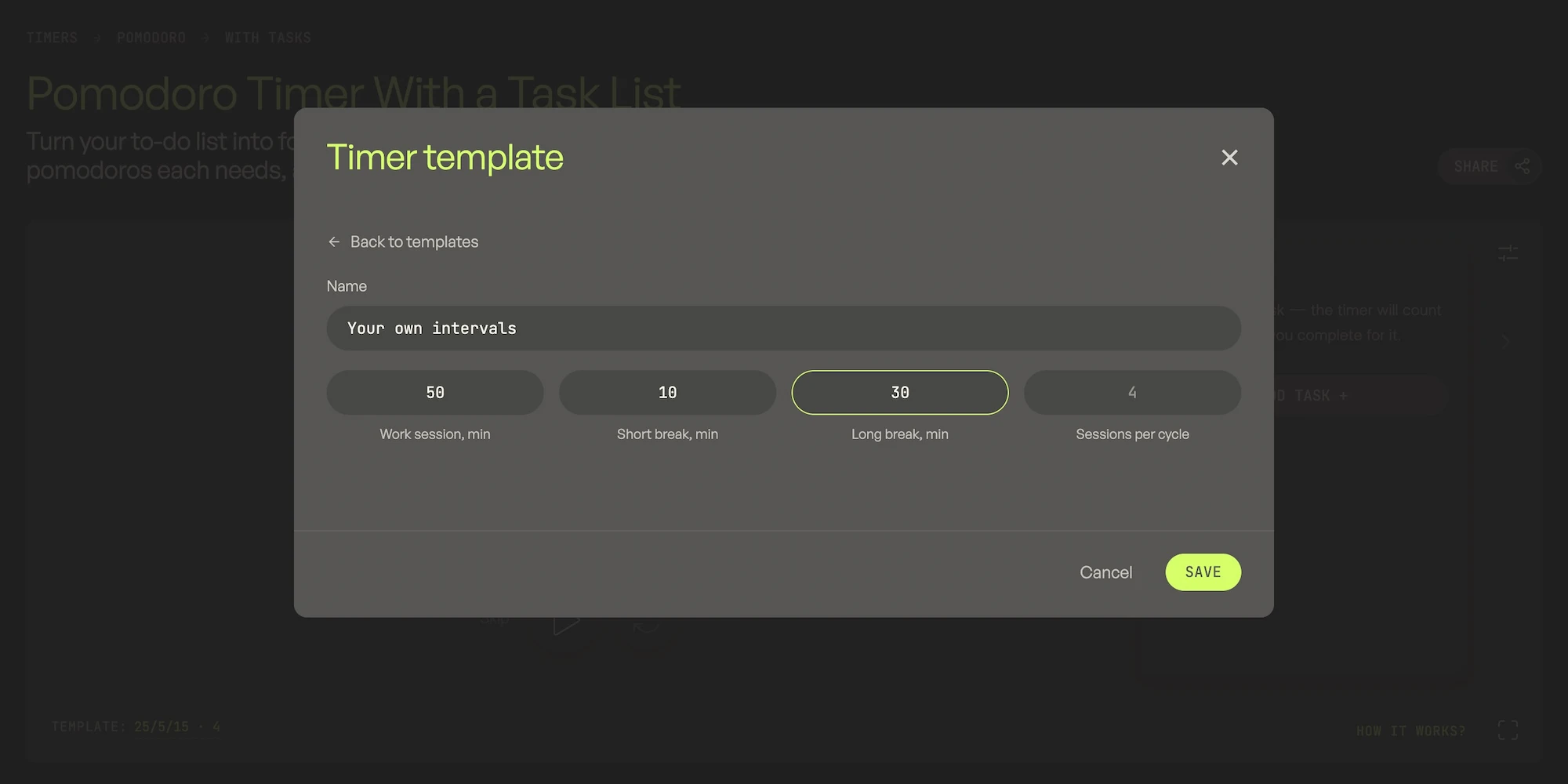
This timer works exactly like the main Pomodoro timer, with one difference: it starts on a custom 50/10/30 rhythm instead of the classic 25/5/15, and the custom-template editor is the point of the page rather than a secondary option. If you'd rather start from the classic ready-made templates and a task list, the main timer is the better starting point.
- Set your own numbers. Open "Custom template" and enter any length for the work session, the short break, the long break, and how many work sessions happen before that long break. There's no minimum or "correct" combination — set whatever you want to try.
- Save up to three templates. Custom templates are stored in your browser and stay available on your next visit, so you can keep, say, a 50/10 rhythm for regular work and a 90/20 rhythm for deep, uninterrupted sessions side by side.
- Switch templates any time. Pick a different saved template from the template picker whenever the task changes — the timer resets to the new template's work length on the next session.
- Everything else still works the same. Auto-start for breaks and work sessions, independent sound and volume for each phase, full-screen mode, and the built-in task list all carry over unchanged from the standard timer.
Popular alternative intervals (and when to use them)
None of the intervals below are prescriptions — they're reasonably well-known starting points worth testing against your own work.
- 50 minutes work / 10 minutes break. Closer to a natural attention span for a lot of adults than 25 minutes, with a break long enough to actually feel restorative rather than just a pause. A solid everyday default for focused desk work.
- 90 minutes work / 20 minutes break — the "ultradian rhythm" approach. Based on long-standing research into roughly 90-minute cycles of alertness and rest across a day. Suited to deep, uninterrupted blocks — writing, programming, studying — when your schedule actually allows a 90-minute stretch without interruptions. Individual cycles vary by 15-30 minutes from person to person, so treat 90/20 as a starting point, not an exact number.
- 52 minutes work / 17 minutes break. A commonly cited alternative to 90/20 for a slightly shorter deep-work block — useful if 90 minutes reliably feels like too much before your attention drops.
- Short or variable intervals (15-20 minutes) for ADHD or trouble getting started. For a lot of people who struggle with focus, the hard part is starting a task, not sustaining it. A short interval lowers the cost of starting — worth trying to see if it fits how you actually work. One practical variant: track roughly when you notice your attention actually drop over a few sessions, then set that length as your interval instead of guessing.
Finding your own number
If none of the above feels obviously right, run a simple one-day experiment: work a session on the classic 25/5, and actually notice when your focus starts to drift — before the timer ends, right at the end, or not at all. Then adjust: shorten the work interval if you're drifting early, lengthen it if 25 minutes still feels easy and you're getting interrupted right as you're in the zone. Lock in whatever you land on using the custom fields above, and don't be afraid to run different templates for different kinds of work.

Fact
The classic 25/5 Pomodoro ratio isn't the result of a study on attention spans — it's simply the length Francesco Cirillo used for himself as a student, timed with a tomato-shaped kitchen timer. There's no evidence it's the objectively "correct" interval for anyone else.