


Where a 25-minute timer fits into your day

Twenty-five minutes is the length of one work session in the Pomodoro Technique, and it's also long enough for a chapter of a book or a short workout. Here are some ways to use a 25-minute timer.
Need a little less or a little more time? Try the 20-minute timer or the 30-minute timer.
- Reading for pleasure or learning:
Set aside 25 minutes to read for pleasure or work. It's easier to make reading a daily habit when the session has a clear end.
- Study sessions:
Divide your study time into 25-minute blocks. This method, known as the Pomodoro Technique, was developed by Francesco Cirillo. After each block, take a five-minute break before starting the next one.
- Naps:
A 25-minute nap can leave you feeling more alert during a demanding day. Keep in mind that longer naps can make some people feel groggy when they wake up.
- Physical exercise:
Fit a yoga session, a run or a set of high-intensity exercises into 25 minutes. It's enough to get your heart rate up without taking over your morning.
- Meditation and relaxation:
Set aside 25 minutes for meditation or deep breathing. It's a longer session than most beginners start with, so try it once short sessions feel comfortable.
- Work tasks:
Approach your work tasks in 25-minute sprints. It's easier to start on a large project if you only need to focus on the next 25 minutes.
Optimizing your routine with a 25-minute timer
Start by breaking larger tasks into smaller parts. If a project usually takes several hours, split it into 25-minute blocks, each with a clear objective.
Protect these blocks from interruptions. Turn off notifications and let others know you're busy. Committing to just 25 minutes of focus is often easier than committing to an open-ended task.
When the timer ends, take a proper break. A cup of tea or a short walk gives you time to rest, and you'll see how much you've completed before you start the next block.
Tips for getting more from a 25-minute timer
- Overcoming procrastination:
Procrastination often comes from a fear of failure or criticism. A 25-minute timer gives you permission to start without having to finish, which can make it easier to get going.
- Rest when you need it:
If you're drowsy in the afternoon, a short nap of up to 25 minutes can help. Set the timer so you don't oversleep.
- Motivation through small wins:
Breaking your work into 25-minute blocks gives you frequent, achievable goals. Crossing them off a list can help you keep going.
- Structured creative sessions:
For writing or design work, use a 25-minute block for brainstorming or drafting. Knowing the session has an end makes it easier to keep going without editing yourself.
- Moving more during the day:
If you sit for much of the day, use the breaks between 25-minute blocks to stand up, stretch or walk around.
- Timed relaxation:
A set time for meditation or mindfulness helps you stop thinking about the clock and pay attention to your breathing.
- Longer breaks after four sessions:
The Pomodoro Technique uses a five-minute break after each 25-minute session and a longer break of 15 to 30 minutes after every four.

Fact
Interestingly, the French once tried to decimalize time under the French Revolution, creating a system where a day consisted of 10 hours, each hour had 100 minutes, and each minute had 100 seconds. This attempt to simplify timekeeping did not last long and was abolished in 1795.
25-minute timer settings
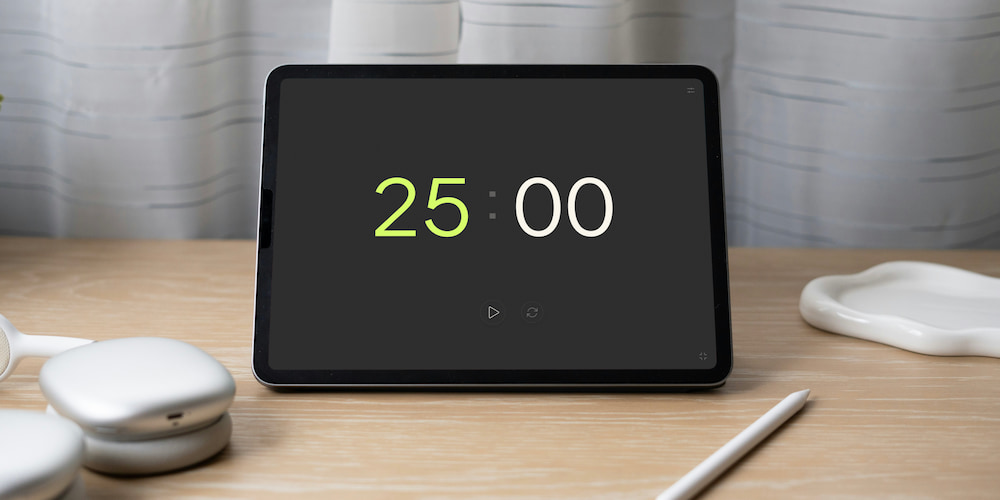
The timer opens at 25 minutes and is ready to start. It's free and needs no install or sign-up.
Sound options:
Choose a gentle chime or a louder alert, adjust the volume or mute the timer to suit your environment.
Typing the time on the digits:
Click the big digits and type a new value without opening a menu. The +/- buttons in the settings also work during the countdown.
Full-screen mode:
Full-screen mode makes the remaining time easy to see during lectures and presentations, which helps speakers keep to their time limits.
Questions about the 25-minute timer and Pomodoro
Short answers about what the 25-minute timer is for and how to use it.
How does a 25-minute timer enhance productivity?
A 25-minute timer helps by setting a clear limit for one task. It makes work easier to start and makes distractions easier to put off until the break.
How do I use a 25-minute timer for work?
Choose one task, start the timer and work on nothing else until it ends. Then take a short break before starting another round.
Can a 25-minute timer help with procrastination?
Yes. A 25-minute timer gives you a defined starting point, so you only need to commit to one session rather than the whole task.
Can I change the sound on the 25-minute timer?
Yes. You can choose an alert sound, adjust the volume or mute the timer.
Why is the Pomodoro Technique 25 minutes?
Francesco Cirillo chose 25 minutes as the work session when he developed the Pomodoro Technique. It isn't a scientifically proven ideal, so feel free to adjust it if another length suits you better.
Can using a 25-minute timer daily improve time management?
It can. Regular use of a 25-minute timer shows how long your tasks actually take, so it's easier to estimate your work and plan your day.