Data refreshes every 5 seconds. Source: WhereTheISS.at (NORAD ID 25544).
On the International Space Station (ISS), the official “local” time is Coordinated Universal Time (UTC).
Here are the main reasons why and how it works:
The ISS is a joint project of numerous space agencies (NASA, Roscosmos, ESA, JAXA, and others). To simplify coordination among different ground control centers, a single time zone — UTC — was chosen. This helps synchronize all operations, communications, and experiment planning.
UTC is determined by readings from a global network of atomic clocks and is adjusted by the International Earth Rotation and Reference Systems Service (IERS). On the ISS, the time is regularly checked against ground control centers, which rely on highly accurate atomic clocks. Thus, the crew on board effectively uses time that is as close as possible to the reference standard.
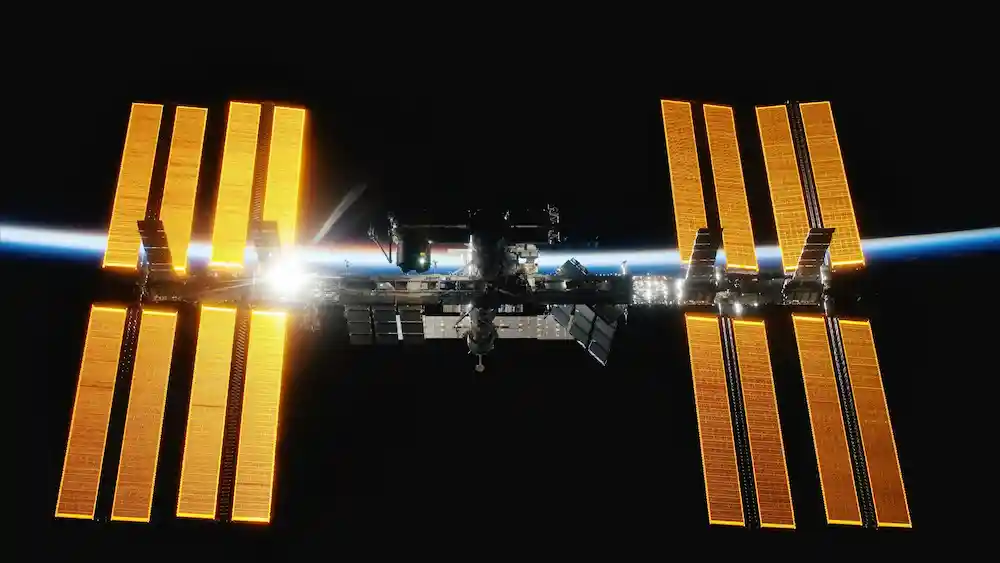
The station completes one orbit around Earth in about 90 minutes and sees up to 16 sunrises and sunsets per day. The concepts of “morning” and “evening” in the Earthly sense lose meaning on the ISS, so a 24-hour schedule aligned with UTC is used to organize the workday.
The crew follows a set timetable for sleep, meals, work, and rest based on this “unified” time.
Typically, the astronauts’ morning starts at around 06:00 UTC, and the “workday” ends in the evening, also by UTC, regardless of how many sunrises or sunsets the station has witnessed that day.
So the official “ISS time” is UTC. It is set and controlled by ground mission control centers on Earth, which rely on a network of highly accurate atomic clocks, ensuring a unified schedule for everyone involved.
The accuracy of the displayed time depends on your device’s time zone settings.